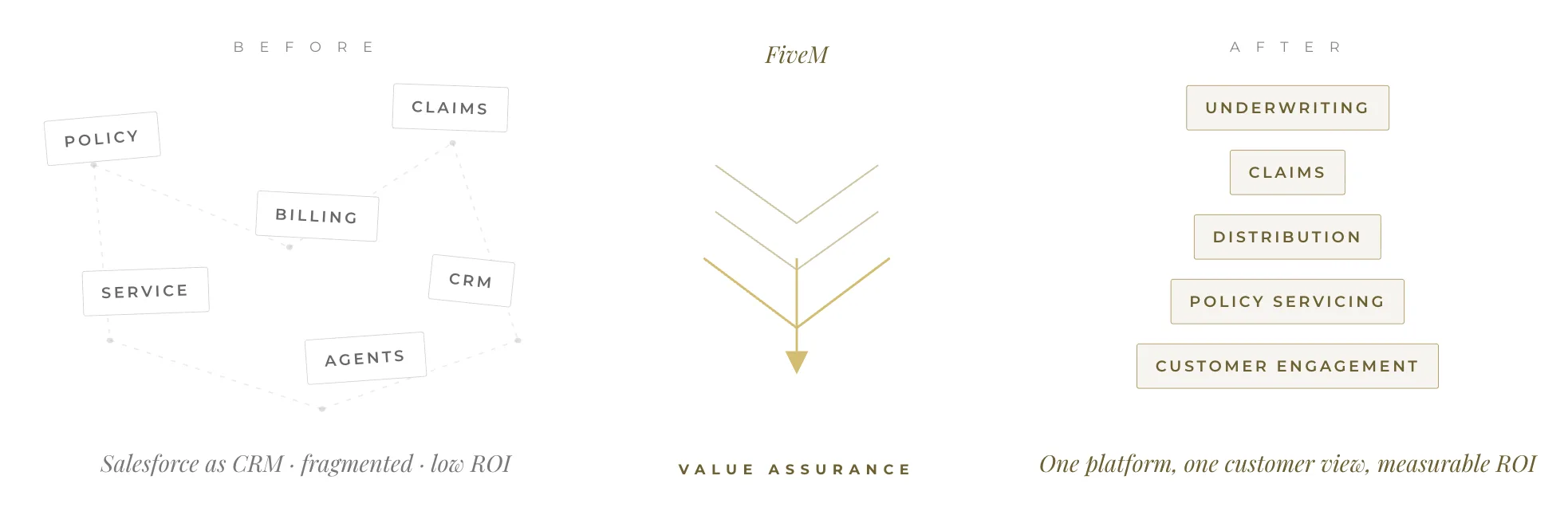
Insurance-focused, solution-oriented Salesforce work — repositioning the platform from CRM to enterprise foundation across underwriting, claims, distribution, and service.
What we deliver.
overview
Most carriers we meet view Salesforce as a CRM. We reposition it as an insurance platform. Using Financial Services Cloud, Data Cloud, Agentforce, and Experience Cloud, we digitize the quote-to-bind process, orchestrate claims, modernize producer onboarding, and unify the customer experience — turning a tool that’s perceived as expensive into one that earns its keep across the value chain.
—Underwriting & new business, quote-to-bind digitization, underwriter workbench, broker portals
— Claims management — digital FNOL, automated triage, AI-assisted severity and fraud detection
Most Salesforce conversations stall on the same handful of objections. We reposition the platform around what insurance leaders actually need to deliver — not seats and licenses.
New Salesforce Customers
what we hear
—”Lack of understanding” —”Perceived as expensive” —”Overbought / low utilization”
how we reposition
Reposition to platform thinking — Salesforce as the insurance operating layer across underwriting, claims, and distribution, not just a CRM seat.
Existing Salesforce Customers
what we hear
—”Salesforce only viewed as CRM” —”Pressure to show ROI” —”How to extract more value / optimize licensing”
how we reposition
Reposition to platform thinking — diagnose what is installed against what is used, retire dead weight, and redirect investment to value-chain workflows that pay back.
four capabilities
One platform. Four capabilities that earn out.
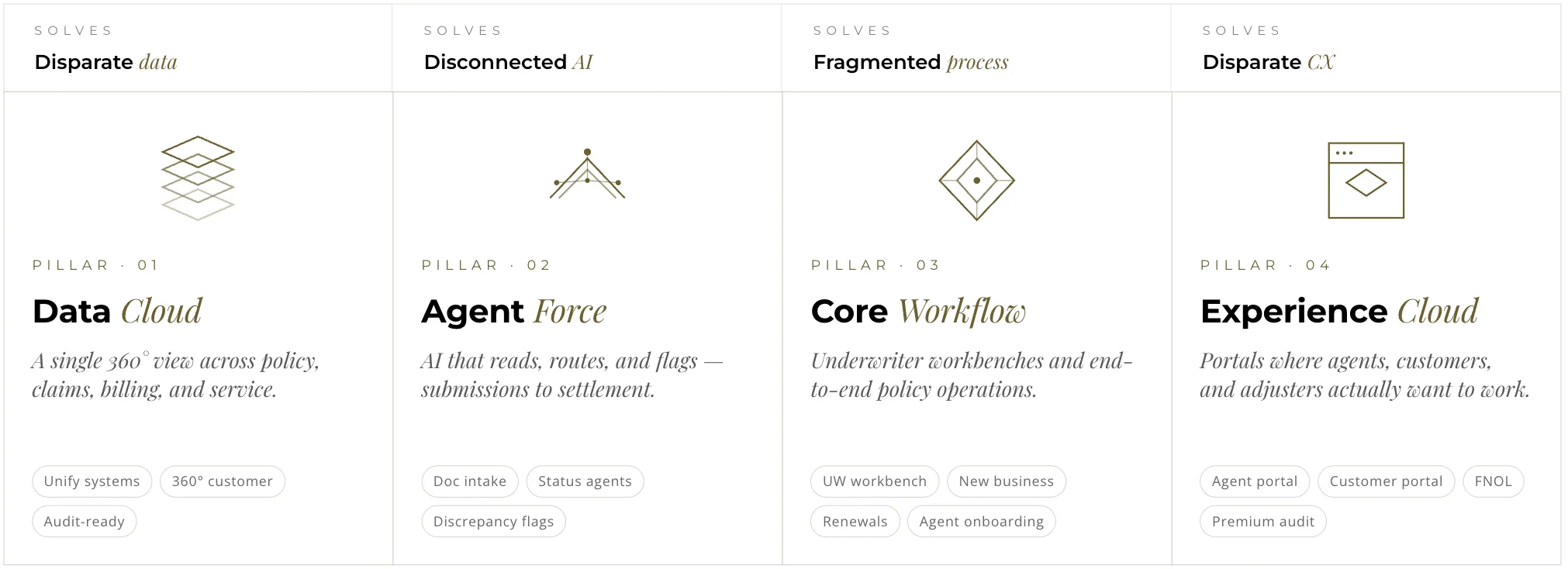
Salesforce only earns its keep when the right capabilities are wired together against insurance work. We sequence Data Cloud, Agentforce, Core (Sales / Service / FSC), and Experience Cloud against the problems carriers actually pay to solve.
Capability 01
Data Cloud
Merge data from multiple admin systems and domains — Policy, Claims, Billing, Service — into a single 360° view of customer, policy, and book.
Why it matters
Eliminates the disparate-data problem that breaks underwriting and service
Foundation for AI: Einstein, Agentforce, and predictive analytics need unified data
Enables real-time dashboards across cycle times, conversion, and claim metrics
Read and process submitted documents, provide submission/policy/claims status, identify document discrepancies — packaged AI agents that work the insurance value chain.
Why it matters
Resolves the “separate AI solutions” fragmentation problem
Built on top of unified Data Cloud — not bolted on
Insurance-specific use cases out of the box, not generic chatbots
Where it shows up
Submission intake and document processing
Status agents for policy, claims, and billing
Document-discrepancy detection on submissions
AI-assisted next-best-action across service and renewals
Capability 03
Core (Sales / Service / FSC)
The system of work — underwriter workbench, general workflow, new business submission, renewal processing, agent onboarding.
Why it matters
Resolves the “no 360° / process fragmentation” problem
Financial Services Cloud data model is purpose-built for insurance
Replaces stitched-together Sales Cloud + custom objects with a tested foundation
Where it shows up
Underwriter workbench and submission workflow
Renewal processing and orchestration
Producer onboarding and contracting
Policy servicing case management
Capability 04
Experience Cloud
Customer-facing surfaces — Agent Portal, Customer Portal, Premium Audit, FNOL — that fix the disparate-CX problem.
Why it matters
Resolves the “disparate CX” problem across web, mobile, and partner channels
Reduces inbound call volume by enabling self-service
Delivers the modern, always-on experience consumers expect from fintech and insurtech
Where it shows up
Producer / agent portal with real-time book of business
Policyholder self-service for documents, claims, and payments
Digital FNOL — file at midnight, captured instantly
Premium audit and renewal collaboration surfaces
across the value chain
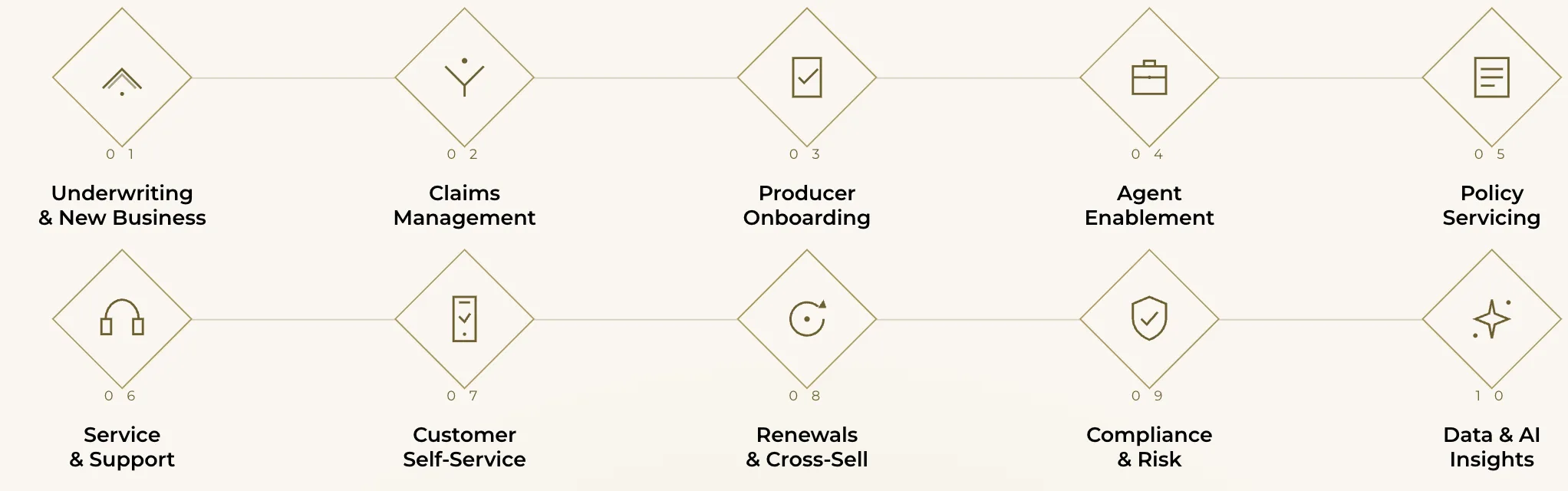
Where Salesforce earns out.
Ten domains across the value chain where Financial Services Cloud delivers measurable business value — not just CRM activity.
01
Underwriting & New Business
Digitize quote-to-bind. Unified underwriter workbench with applicant data, prior policies, and third-party feeds. Faster, more accurate decisions; better hit ratios.
02
Claims Management
Digital FNOL through settlement. Service Cloud orchestration, AI-assisted severity and fraud detection, proactive customer updates.
03
Producer Onboarding
Replace 90-day paper processes with 21-day digital onboarding. NIPR integration, training, and contracting tracked in one flow.
04
Agent Enablement & Channel Management
Unified producer portal with book of business, commissions, and performance dashboards. Real-time channel analytics.
05
Policy Servicing & Administration
Front-end for endorsements and changes, integrated to core admin. Single audit trail across multiple back-end systems.
06
Customer Service & Omnichannel Support
360° service console across phone, email, chat, and social. Einstein next-best-response and knowledge surfacing.
07
Customer Self-Service & Digital Engagement
Experience Cloud portals for documents, payments, and service requests. Reduces inbound call volume; meets fintech-grade UX expectations.
Salesforce Shield, audit trails, producer license compliance accelerators. Compliance built into workflows, not bolted on.
10
Integrated Data & AI-Powered Insights
Data Cloud unification, Einstein and CRM Analytics for underwriting, claims, and operational decision support.
delivery
How we build it.
Our 7-phase delivery lifecycle — designed for regulated insurance environments. Iterative, not waterfall; senior practitioners embedded through go-live and into optimization.
phase 01
Discovery & Strategic Planning
Discovery sprints to understand business needs, user pain points, and technical constraints. Output: validated product concept, technical feasibility analysis against Salesforce limits, roadmap with measurable KPIs.
phase 02
Environment Strategy & Architecture Foundation
Set up environments (Dev, Sandbox, Scratch Orgs), version control with Git, CI/CD via DevOps Center / Copado / Gearset / AutoRABIT. Define metadata movement, development model, and roles. Compliance: data masking, audit logging, field-level encryption.
phase 03
Design for Scalability, Security & Future Releases
Data model design for performance and flexibility. Security: MFA, encryption, masking. Access control via role hierarchy and permission sets. Automation strategy across Flow and Apex.
phase 04
Iterative Development — Agile + DevOps
Data model design for performance and flexibility. Security: MFA, encryption, masking. Access control via role hierarchy and permission sets. Automation strategy across Flow and Apex.
phase 05
Controlled, Feedback-Driven Release
Rollback planning and backups. Change sets, unlocked packages, or CI/CD-managed releases. Pre-deployment validation, smoke testing, performance verification, full release notes.
Adoption metrics, friction monitoring, edge-case remediation, feature-request triage. Agile continues — the system evolves with business needs and Salesforce releases.
approach
How we work.
Managed Service model
We deliver Salesforce work in a structured 7-phase lifecycle — engineered for regulated insurance environments where compliance, integrations, and change-management gravity are non-negotiable.
Phases run iteratively rather than waterfall: Discovery → Environment & Architecture → Design → Iterative Development → Testing & QA → Controlled Release → Post-Deployment Optimization. Senior insurance practitioners stay embedded through go-live and into the optimization cycle — not just up to the steering-committee handover.
Whether you are new to Salesforce or extracting more value from an existing footprint, the operating model is the same: insurance-focused, solution-oriented, and grounded in the value chain — not in seat counts.
— Discovery & strategic planning sprints
— Environment, DevOps, CI/CD setup
— Scalable, secure data-model design
— Agile, iterative development
— End-to-end testing and user validation
— Controlled, feedback-driven release
Next Practice
Transformation Assurance
An independent, senior execution and risk-assurance layer that sits between you and the SI — protecting outcomes, decisions, and value realization on your most consequential programs.