Practice 04

Business Driven
Enterprise Architecture
A facilitated, multi-phase intervention that brings business and technology leaders together to design how the enterprise should work and how technology should support it.

What we deliver.

overview

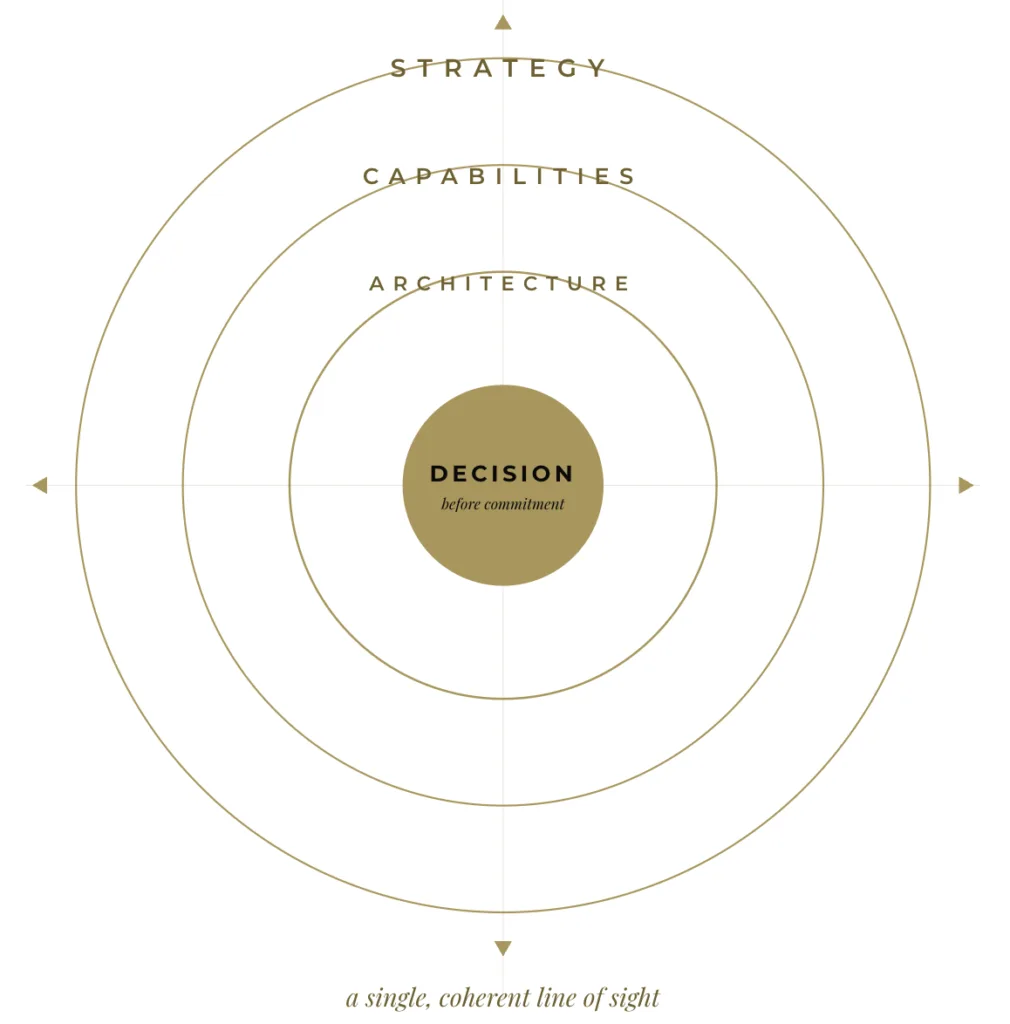
BDEA is for insurance organizations that recognize their technology decisions feel expensive, slow, and difficult to reverse but cannot clearly explain why. It is not EA modernization. It is not a tooling rollout. It is a deliberate reorientation of how leaders see and decide about the enterprise: capability-led, decision-oriented, and tied to value. We start with friction in how work actually gets done, derive jobs-to-be-done, define capabilities at a decision-useful level, separate logical from reference architecture, and translate trade-offs into a fundable roadmap with governance that survives delivery.
— Business-owned capability model at a decision-useful level
— Jobs-to-be-Done derived from observed friction, not personas
— Logical and reference architecture separated by design
— Architectural option sets with explicit trade-offs
— Fundable, sequenced roadmap with documented decisions
— Optional Ardoq operating model and sustainment cadence

what DBEA Isn’t

Three things BDEA is not.

BDEA is regularly miscast as a tooling exercise, a documentation effort, or a strategy deck. It is none of these. The clearest way to position it is by contrast — what it is not, and what changes when it works.
BDEA vs. traditional EA

where it gets confused

-Documents systems and integrations
-Acts as a tollgate after decisions are locked
-Defensive posture — slows delivery without improving it
-Artifacts go stale within weeks of being produced

what bdea does

BDEA enables decisions before capital is committed. Architecture earns its place by improving outcomes upstream — not by enforcing standards downstream. Decisions are documented so they can be revisited, not so they can be filed.
BDEA vs. strategy consulting

where it gets confused

-Defines direction at a high level
-Stops at intent — execution is “someone else’s job”
-Slide-led, not capability-led
-Hands off without the operating discipline to sustain it

what bdea does

BDEA designs how strategy is executed coherently. Capabilities, jobs-to-be-done, and architectural trade-offs become the connective tissue between strategy and delivery — owned by leaders, not consultants.
BDEA vs. tool implementations

where it gets confused

-Document reality after the fact
-Capability models stop at Policy Admin / Billing / Claims
-Tooling without behavioral change
-Risks are captured but not managed

what bdea does

BDEA shapes reality. Tools — including Ardoq — are introduced only after the discipline exists to use them. Capabilities are defined at the level where reuse, differentiation, and complexity actually live.

field evidence

What changes when leaders see
commonality across silos.
A large specialty-lines P&C carrier engaged FiveM to bring coherence to a fragmented ecosystem. Using friction mapping, verbs over systems, JTBD, and capability modeling, the team established a common language across business and IT. For many leaders, it was the first time they could see commonality across business units that had long been hidden under nuanced terminology.

30%

reduction in supporting applications across the ecosystem — specialty-lines P&C carrier engagement.

30%

improvement in maintainability across shared services and reusable patterns.

10-16

weeks from kickoff to a fundable roadmap — typical BDEA engagement duration.

four phases

A facilitated journey from friction to
framework.
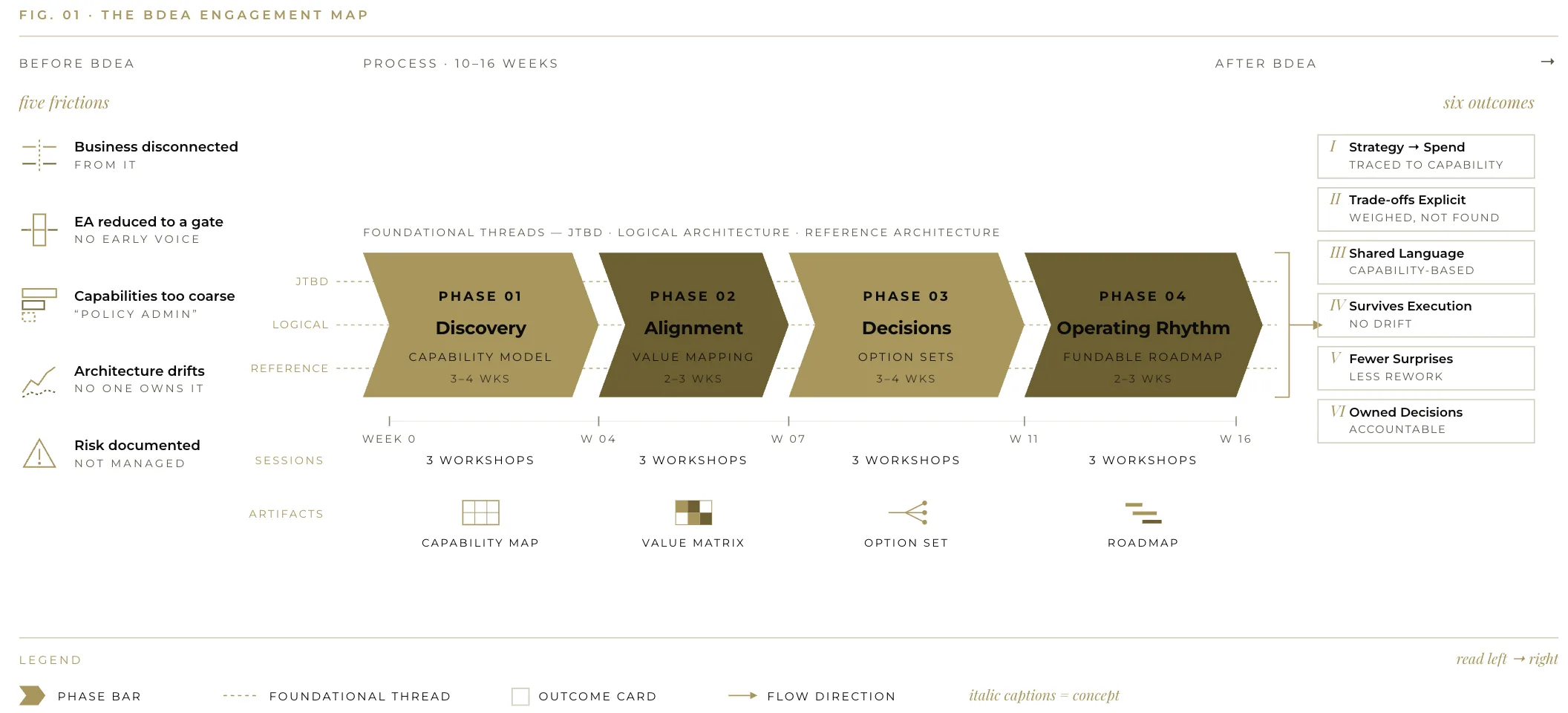
BDEA is delivered as four sequenced phases over 10–16 weeks. The work is heavy on facilitation and reeducation early — most leaders have never been asked to describe their business without referencing systems, teams, or vendors. We reset that muscle before asking leaders to make architectural decisions.

phase 01

Business Capability Discovery
Establish a shared, business-owned understanding of what the organization must be able to do to execute its strategy. Duration: 3–4 weeks.

What happens

  • Executive Framing Session — confirm strategy, scope, decision authority
  • Value Stream Decomposition Workshops (3–5 sessions) — verb-based, friction-led
  • Capability Normalization Sessions — consolidate, resolve overlap, define ownership
  • Cross-LOB capability discovery — find commonality hidden under different terminology

Artifacts produced

  • Enterprise capability model at a business-relevant level
  • Capability definitions and ownership assignments
  • Initial capability heat map
  • Shared language between business and technology

phase 02

Capability-to-Value Alignment
Tie each capability to measurable business outcomes and value drivers. Move leaders from describing the business to evaluating it. Duration: 2–3 weeks.

What happens

  • Value Mapping Workshops linking capabilities to growth, efficiency, risk, experience
  • KPI and Value Hypothesis Sessions — surface implicit assumptions
  • Performance gap discussions grounded in insurance economics
  • Capability prioritization based on value, not delivery convenience

Artifacts produced

  • Capability-to-value matrices
  • Value hypotheses and KPI definitions
  • Capability prioritization model
  • Business-owned view of what matters most

phase 03

Architecture Decision Design
Use architecture to inform explicit, documented trade-off decisions. Move architectural decision-making upstream, before the cost of change is high. Duration: 3–4 weeks.

What happens

  • Current State Capability Overlay — map systems to capabilities, find redundancy
  • Future Option Design Workshops — develop architectural option sets
  • Decision Review and Trade-Off Sessions — speed, cost, flexibility, risk made explicit
  • Risk acceptance is deliberate and recorded — not accidental

Artifacts produced

  • Capability-to-system mappings
  • Architectural option sets with documented trade-offs
  • Explicit risk acceptance records
  • Decisions recorded so they can be revisited

phase 04

Roadmap & Operating Model Design
Translate decisions into executable, governable action. Embed capability thinking into operating rhythms so it survives execution. Duration: 2–3 weeks.

What happens

  • Roadmap Sequencing Workshops — initiative waves, dependencies, timing
  • Governance and Ownership Design — decision forums, escalation paths
  • Sustainment Planning — review cadence and ongoing maintenance
  • Optional Ardoq implementation as the system of record, after discipline is established

Artifacts produced

  • Fundable initiative roadmap
  • Architecture governance model
  • Decision review cadence and forums
  • Capability, decision, and dependency models — living, not static

friction to framework

The five-step modernization blueprint.

Cutting across all four phases is the same core sequence — the FiveM modernization blueprint. Each step builds on the last, moving from how work actually happens today to a technology strategy informed by business logic, not platform preferences.

step 01

Friction Mapping

Identify the actions — how work actually happens today. Illuminate where things break down or stall. Outcome: a shared understanding of what drives value and where effort accumulates.

step 02

Verbs Over Systems

Decompose the business in verb-based terms — what people do, not what systems do. Outcome: a prioritized view of the barriers to value creation, free of system-first bias.

step 03

Jobs to Be Done

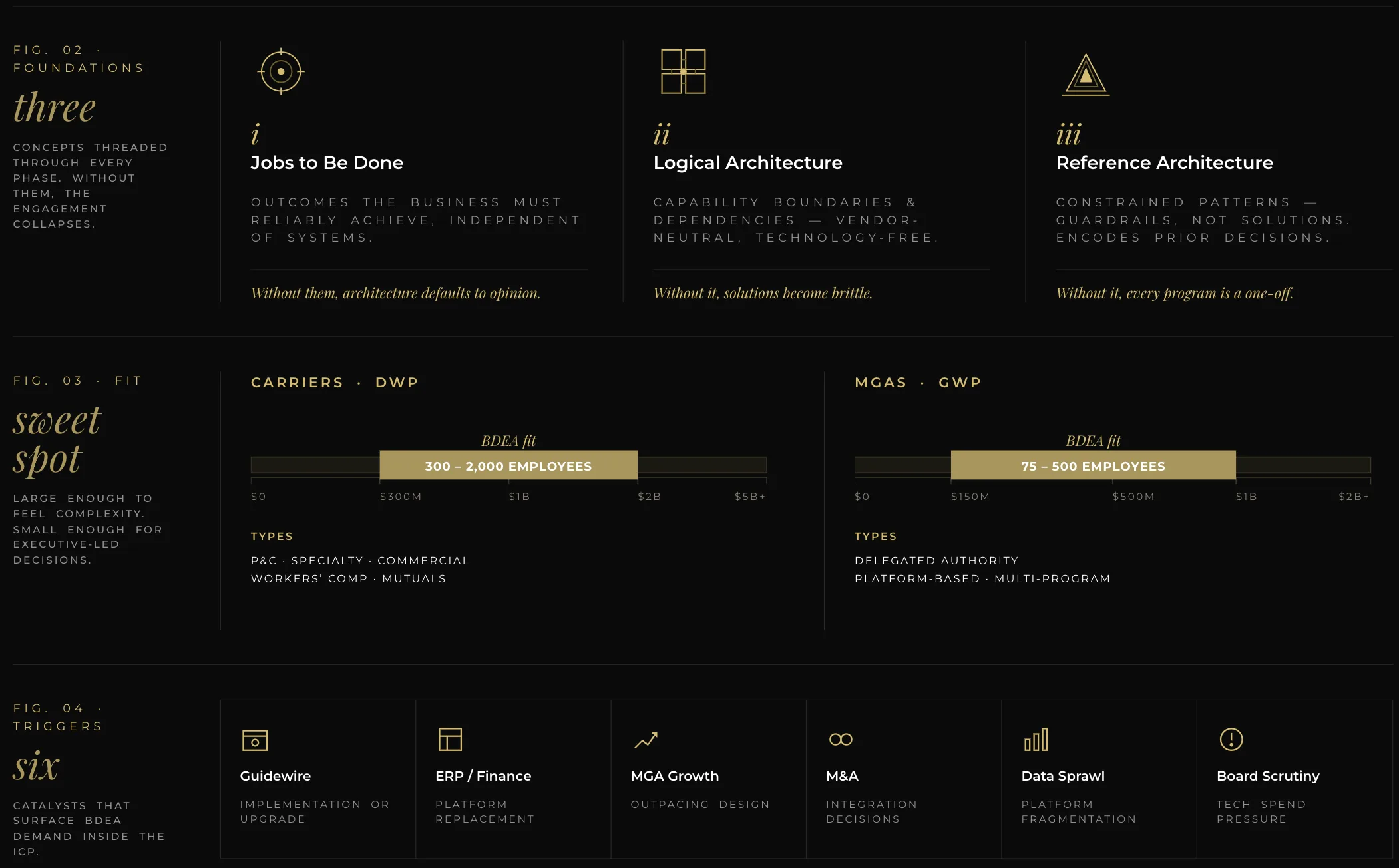
Reframe pain points into purposeful business objectives. JTBD are precise statements of what the business must accomplish, derived from observed friction — not personas, not innovation theater. Outcome: clarity on what success means from a customer, employee, and business lens.

step 04

Capability Definition

Define the essential capabilities needed to deliver on those jobs — at a decision-useful level. Outcome: a blueprint that connects business outcomes to process and technology enablers.

step 05

Logical Architecture

Design how systems, data, and interactions must align to enable those capabilities. Logical first, reference second. Outcome: a technology strategy informed by business logic, not platform preferences.
approach

How we work.

engagement model

Typical engagement runs 10 to 16 weeks across four phases — Capability Discovery, Capability-to-Value Alignment, Architecture Decision Design, and Roadmap & Operating Model. Sessions are facilitated working sessions, not presentations. We actively interrupt system-first and project-first language and coach leaders in real time.

Senior facilitators only — former CIOs, COOs, and product owners who have sat in the same seats as your leaders. Tools like Ardoq are introduced after discipline exists, not before.
— Senior-only facilitation — no analysts driving sessions
— Working sessions, not status decks
— Insurance-grounded — facilitators come from the carrier world
— Decisions documented and revisited, not just produced
— Optional follow-on: architecture sustainment or Transformation Assurance

Next Practice

Regulatory Risk Managament Office

A combined Security, Privacy, and GRC managed service that runs your regulatory function on an ongoing basis — built for regulated insurance entities.

Get the Free Case Study

The Transformation Blueprint

Download the full case study to see how FiveM helped a specialty lines carrier cut through complexity, align business and IT, and reduce redundant applications by 30%—unlocking a more scalable, cohesive foundation for growth.

Ready to talk about
business?

A 30-minute introductory call. No deck, no pitch.

Free e-book

5 key lessons in modernization

FiveM has extensive experience advising leaders on modernization initiatives, resulting in valuable insights and “The Five Key Lessons” for digital transformation.